
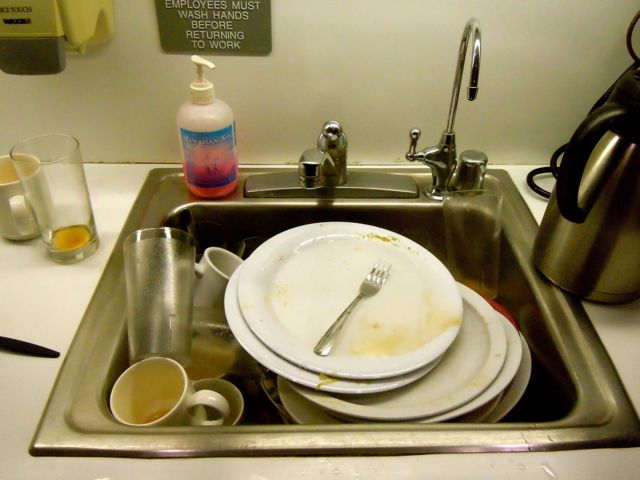
In a break room kitchen area at a well-known University in Australia my friend Sarah faced a site sadly familiar to far too many of us. The messy break room! Who left it a mess was a mystery, but a mess it was and no amount of cleaning up after the mystery messy person, or persons was solving the mystery or inspiring new cleaner and more courteous behaviors.

Those familiar with these types of situations know that even notes reminding the mystery messy that “Your mother doesn’t work here” or ” Please be courteous to co-workers” – (as well as other notes threatening bodily harm doesn’t seem to help) Nor does ignoring the mess hoping that … eventually it would get bad enough for the perpetrators to awaken to the unhealthy results of their pig like behavior. Even labeling the kitchen as a bio-hazard won’t awaken the cleaning and survival instincts of the average mystery messy co-worker(s).

SO what can we do when the promise or hope of a relaxing and refreshing break in a clean and inviting break room seems impossible. When we realize we have joined the ranks of others who also couldn’t stand or stomach the mess and have taken to eating somewhere else or in their offices alone. The break room is, or can and should be a place of gathering. A place where people can re-group and re-connect. In short a great break room can be an asset to creating a great culture.
Well I think we can learn a lesson from my friend Sarah.
So how did Sarah solve the Mystery of the Messy Breakroom? She used a positive approach and seemed to have great success with the power of praise. That crazy idea of ”catch people doing something right” also expressed in these words, “We almost always see more of the behavior we spend time calling attention too.”
Here are the 3 things that Sarah did to solve the mystery and kill the criminal behavior without every needing to catch the criminal.
Sarahs 3 Clues to improve culture.
In her words… thing 1) As they cleaned a cup or spoon, I said, “Hey, thanks for that – you know, it’s so good to see people doing their bit”
In her words… an e-mail – thing 2)
Colleagues,
My grateful thanks to all of you who have pitched in this week to keep our kitchen clean. It is Friday afternoon and I have just got myself a cup of tea from a sparkling clean kitchen area. I particularly want to thank the person who cleaned the microwave and also the gentleman who cleaned the lids of the tea and coffee containers. Every little action contributes to a collective whole that works to the common good. These things may seem trivial but they are indicators of a broader attitude to social and personal responsibility. In those moments where we need a break and a coffee (or tea) or lunch – the environment should not be the source of stress or disappointment – and this week, thanks to you, it has been a pleasure to make lunch or tea in the first floor kitchen.
I left some chocolates earlier this week to say thanks – no doubt I (and others) will continue to show appreciation in other tangible ways. But for now, let me again say thank you to all of you who have done your part. It has made everyone’s experience of lunch and tea-time a much more pleasant one.
Have a great weekend.
Cheers
Sarah
Thing 3 – the NOTE and the Chocolates.
It said.
To those of you who have cleaned up after yourself and kept this kitchen clean – please take a chocolate with my thanks, Sarah
p.s. to the person who keeps leaving their dirty spoons on the drainer for others to clean, step up and keep your mitts off these chocolates until you do.
And finally … a picture of the actual break room kitchen looking good. A CULTURE ON THE CLEAN. Well done Sarah and colleagues.

I think it’s important to also point out what Sarah didn’t do. She didn’t install a camera to catch the guilty. She didn’t go to HR to report the problem. She didn’t waste time printing clever and condemning signs to guilt and shame people into better or changed behavior. She instead focused on the desired behavior caught people doing it and praised them, often in the very act. She recognized and reinforced the positive and desired behaviors with words in person and in print and even with chocolate…YUM.
If you are familiar with Chip and Dan Heath’s book “Switch” on How to Change Things When Change is Hard you can see how Sarah wisely worked to touch all 3 aspects of creating real and lasting change. She used a simple positive and proven approach that offered something to the elephant, the rider and also shaped the path. And in the end as Sarah said in her e=mail to her colleagues… Every little action contributes to a collective whole that works to the common good. These things may seem trivial but they are indicators of a broader attitude to social and personal responsibility.
Her pleasant but persistent and principle centered approach led to the desired and pleasant outcome. Again quoting Sarah,
”But for now, let me again say thank you to all of you who have done your part. It has made everyone’s experience of lunch and tea-time a much more pleasant one.”
Perhaps the change we seek requires less policy and policing and more of a positive and principle centered approach. After all it is people and relationships we are interested in, not break rooms. You can’t teach a break room anything…but if you are patient, persistent, wise and caring you can teach people almost anything. Sometimes even things that their mothers could not. 🙂
Kirk out
 Mzsunflower's Say What?